
How is it that the some street photographers always seem to be able to capture the most fleeting of moments which will most likely never happen again? How do they always seem to be in the right place at the right time with their camera at the correct settings and with the perfect background, light and composition? How does their subject seem to be striking exactly the right pose and looking exactly where the photographer wanted he or she to be looking?
How did that serendipitous twist of fate somehow bring all these elements together, just as the photographer was “passing by”?
Was it intent or accident on the part of the photographer that enabled them to capture the image or did they ‘design for serendipity’?
Over the years, and admittedly very intermittently, I have spent a long time not just doing but thinking and reading about photography in general and street photography in particular. But, even after all these years, I feel I have never quite captured anything close to the masterful images of the likes of Henri Cartier-Bresson’s Behind the Saint-Lazare Station, Diane Arbus’ The Child with a toy hand grenade in Central Park, N.Y.C or anything by Robert Frank in The Americans.
Still, I carry on practising my art.
All the time I strive to do something that is slightly above average and hopefully more meaningful than what Steve Mansfield-Devine refers to as “indifferently composed images of random people doing uninteresting things on anonymous streets”.
Ouch!
So what have a I learnt after all these years?
What is it that the successful practitioners of the art of street photography do that sets their images apart from the countless mediocre images we see plenty of?
How do they ‘design for serendipity’?
Of course there are the usual ‘rules’ about always carrying a camera, make sure you preset so you don’t have to fiddle around with shutter speed or aperture etc and staying in one place and watching out for something to happen. Heck, I’ve written lots about about these myself.
I also think however that there are more photographers can do to improve their keeper rate by being ready when those serendipitous moments occur. Here are some of my thoughts.
All of the images used in this post are my own. I am not including them to say what great images they are. I’m just using them to illustrate a point.
Put in the time
”The more you photograph people on the street, the more in tune you will be with your surroundings.”
Valérie Jardin
You may be extremely lucky and take some great photographs the first time you embark on your street photography but for most of us it’s simply about burning shoe leather and wearing your legs out.
You just have to put in the time.
Whether you go out intentionally to take some street images or whether you are simply carrying your camera with you on the off-chance something will cross your path that is worth photographing the more you do either of these things the more chance you will have of capturing a decent image occasionally.
If you look at the website of Valérie Jardin you will see hundreds of very good street images that have been captured over many years from all over the world. I am fairly sure these account for quite a small proportion of images she has actually taken during that period and they represent a very small part of the time she has spent walking those streets.
Ms. Jardin has certainly put in the hours.
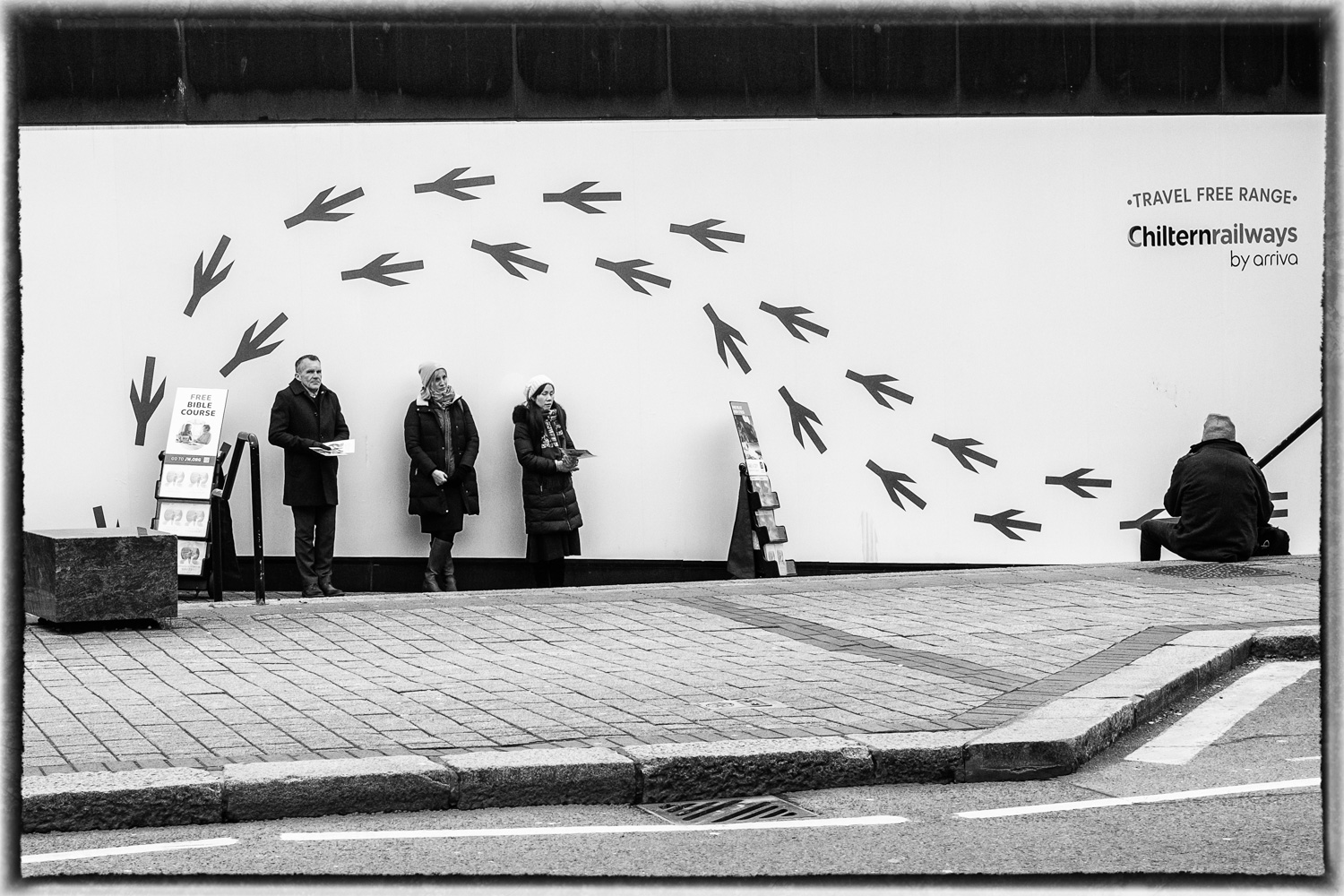
The above image was taken after a long day walking the streets of Birmingham which, as my home city, is a place I have frequented a lot over the years. Many days trudging the streets of Birmingham have resulted in precisely zero keeper images. This picture was taken right at the end of the day just as I was walking to the station to catch the train home. The three bible course promoters standing under chicken footprints walking over these people reminded me of what many of us do by skirting around such folk, avoiding any eye contact that may cause them to try and engage us in a conversation. To me, the picture had something to say and was my reward for putting in the time that day.
Don’t sweat the composition too much

“Sharpness is a Bourgeois concept.”
Henri Cartier-Bresson
Sometimes not all elements of a street image come together in exactly the way the photographer intended. Composition may not quite be right, lighting may not be the best and some elements might be out of focus or blurred. At times, especially when looking at images retrospectively, you realise that actually, it does not matter that a picture is not pin sharp or beautifully composed. Blurring, especially in street photographs, can add to, rather than take away from, an image. After all, streets are full of motion whether from people or traffic or birds or just the general hustle and bustle one expects from a busy place.
The above image was taken in a part of Birmingham that was about to be redeveloped. It was an area famous for its Brutalist architecture. A few days after this picture was taken the whole area was closed off and demolition started. I was trying more than anything to capture the architecture because, love it or hate it, it was about to disappear for good. It was a dull January morning and I had a slow shutter speed which did not matter for photographing buildings however I did not notice the woman who was quickly walking through the area as though trying to escape before the whole lot came tumbling down. When editing my images later I almost discarded this one but decided the blurring added to it by saying something about what was about to happen to that area.
Don’t be afraid to post-process
“I always found it rather pathetic that as a photographer I would be dependent to such a large extent on sheer luck… So the moment I was offered [digital] tools to bend the shape of the image into my choices, and not those of lady luck, I was hooked.”
Pedro Meyer
Henri Cartier-Bresson famously did no, or very little, manipulation of his images. He says in his book The Mind’s Eye that:
“Our task is to perceive reality, almost simultaneously recording it in the sketchbook which is our camera. We must neither try to manipulate reality while we are shooting, nor manipulate the results in a darkroom. These tricks are patently discernible to those who have eyes to see.”
Henri Cartier-Bresson
Cartier-Bresson died in 2004, digital cameras were still in their infancy and anyway he had pretty much given up photography in favour of drawing during the late 1980s. He would not have been tempted or seduced by what digital tools could have offered but even if they were available to him I doubt he would have used them. The power and the impact of Cartier-Bresson’s images was in the way they recorded very directly what was happening in front of his camera — in the moment with minimum interventions from him whilst taking the image, or afterwards.
But we’re not all Henri Cartier-Bresson.
And we do have amazing digital tools at our disposal.
So why not use them?
Responsibly.
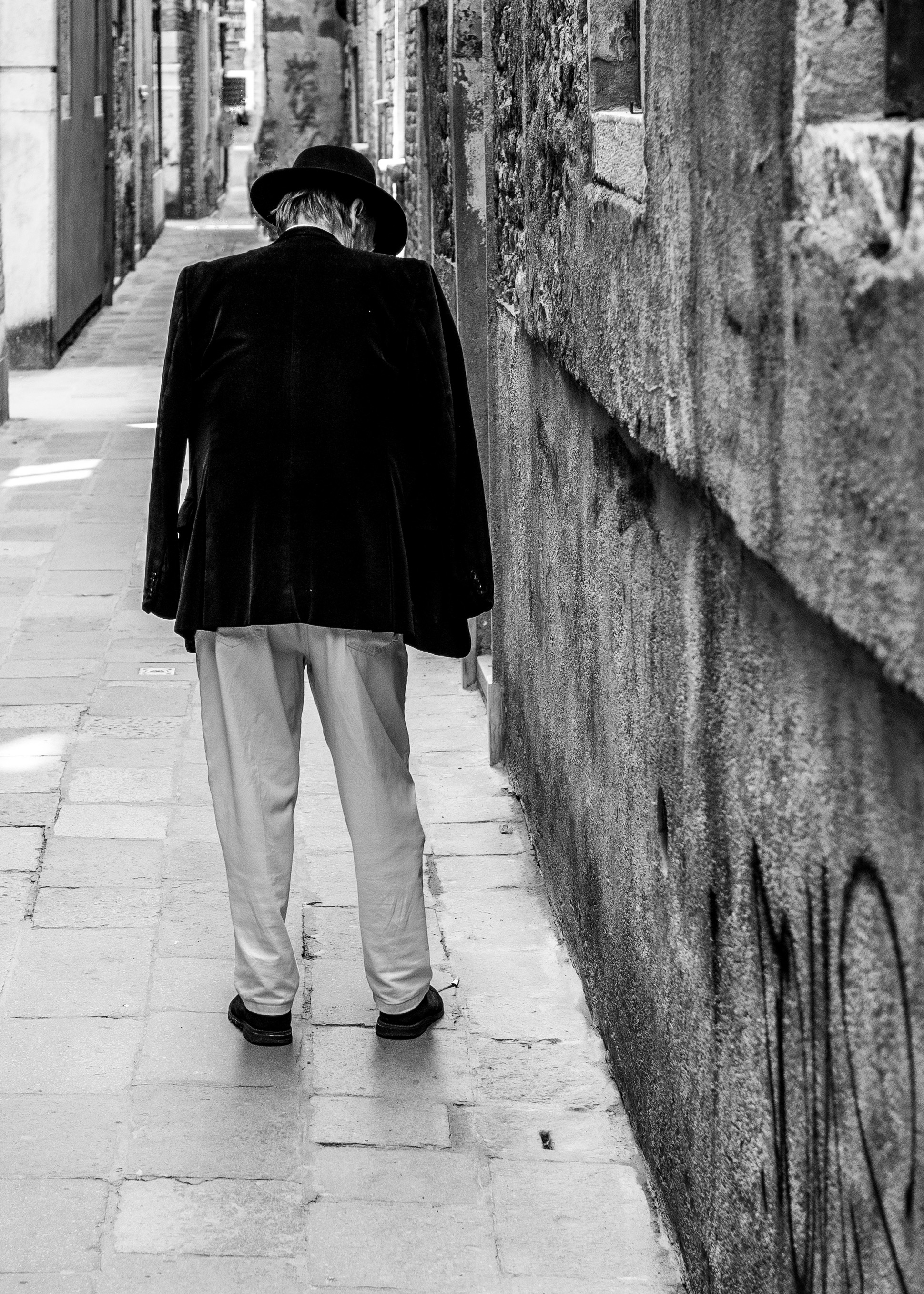
For me the above image has had quite a lot of editing for a street photograph. Here’s the original.

As well as the obvious cropping, contrast boost and conversion to black and white (in Lightroom) I also used Photoshop to remove the people at the end of the street — not something I typically do. For this however I wanted the focus to be purely on the gent – with no distractions.
The point here is that if a bit of post-processing is needed to improve your luck and can recover an image that might otherwise have been lost then why not? How much editing you do is obviously up to you. For me, most of the time I just crop, boost contrast and convert to black and white. Removing, and certainly adding things, is usually a big no, no — but sometimes I feel it is necessary.
As long as you stay within your defined ethical boundaries (which admittedly can be a somewhat amorphous concept) then editing, as Joel Meyerowitz says,“is you refining your identity” [as a photographer]. It helps others to see “the clarity with which you percieve and appreciate the world”.
But, certainly no AI!
Add to your library more often than to your gear

“Buy books, not gear.”
Eric Kim
I am an unapologetic buyer of photobooks. As Joel Meyerowitz says “You are lucky to be living at a time when photography books are abundant”.
For me photobooks enable you to enter the minds of the photographers, to understand their journey and help you understand why and how they went about making their images as well as putting them together in book form (something I have now started to do in earnest).
It’s not about copying their work but using it for inspiration and to make your own interpretations. By immersing yourself in the work of some of the photographic greats I am convinced there is some process of osmosis going on whereby if you imbibe yourself so much in their work it becomes a part of you. Their experience serves as a way of helping you see things you would not necessarily have considered a worthy image to take (or make).
As an example I am convinced I would have not taken or edited my image above of the gent in a backstreet of Venice if I had not been aware of the image Man Against Snow, Austria (1974) by the British photographer Paul Hill. Having seen Hill’s photograph I’m sure I was influenced by it, not just when I took the image but certainly when editing it in the way I did.
Occasionally Lady Luck is just kind to you
“Of course, it’s all luck.” — Henri Cartier-Bresson
Sometimes, very rarely, an exceptionally fortunate set of circumstances combine which can be ascribed to chance, supernatural forces or divine intervention and a situation unfolds right in front of you that screams “capture me”.
Lady Luck has struck and you just need to capture the moment.
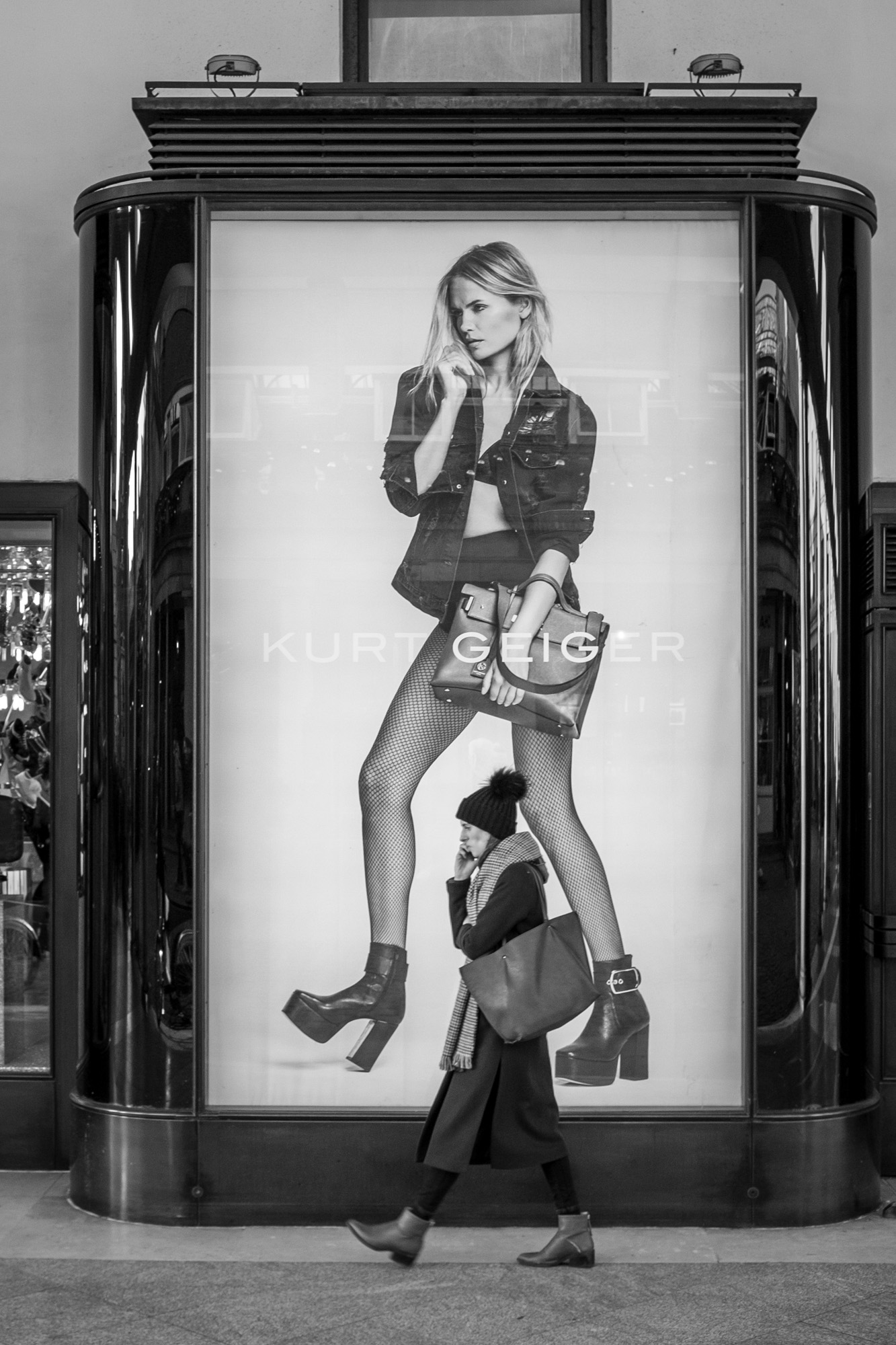
This is the situation for me with this image. I was in London on a work trip and walking back to the station rather than using the London underground. The picture of the model in the Kurt Geiger advert caught my eye as a number of people were walking past it. By chance I raised my camera just to frame the image and clicked the shutter just as this woman walked in front of to it. It was only when I looked at the image later on the train home I realised the wonderful congruity of the passerby with the image in the advert — short boots with heels, similar walking pose, a bag under the left arm and the right arm held up to the face. This is probably as close to a “decisive moment” as I will ever get.
If Lady luck is kind to you, be thankful and go with it.
References
- Jardin, Valérie, Street Photography — Creative Vision Behind the Lens, Routledge, 2018
- Mansfield-Devine, Steve, Privacy vs expression: the ill-defined ethics of street photography, https://medium.com/cameralux/privacy-vs-expression-the-murky-ethics-of-street-photography-cb78396bac69
- Gibson, David, The Street Photographers Manual, Thames & Hudson, 2023
- Meyerowitz, Joel, How I Make Photographs, Laurence King Publishing Ltd, 2019.
- Hill, Paul, Approaching Photography, Routledge, 2020
- Cartier-Bresson, Henri, The Minds Eye — Writing on Photography and Photographers, Aperture, 1996

 Peter Cripps
Leave a comment