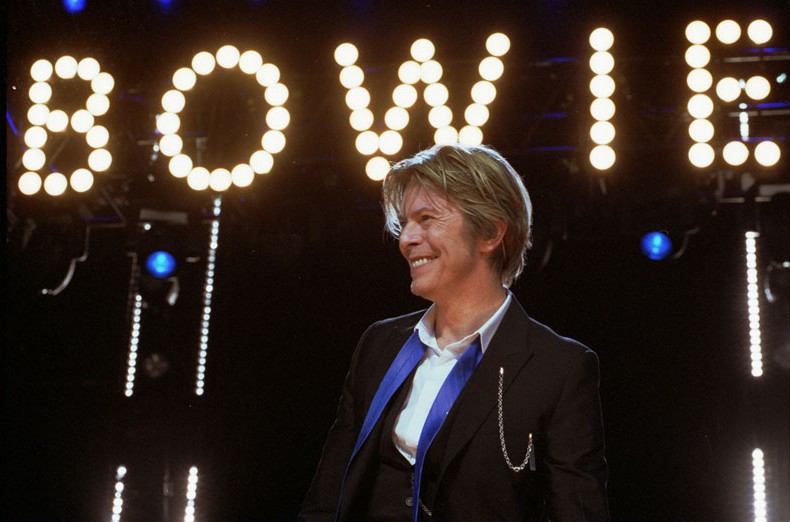
Today, January 10th, 2026, is the tenth anniversary of David Bowie’s death. No doubt there will be many tributes to one of the greatest creative minds of the music world, not just in mainstream media but by his many fans from around the world. I am one of those fans and still listen to his music and watch films and videos about him and his work. He will always carry on playing a part in my life and influence my own creativity.
One of the things that has always intrigued me most about Bowie are these words which he said in a 1976 interview published in Playboy (September 1976), where he was interviewed by Cameron Crowe 1. In that interview, when asked if he considered himself “an original thinker,” Bowie replied, “Not by any means. More like a tasteful thief. The only art I’ll ever study is stuff that I can steal from.”
What did Bowie mean by this and did he even mean what he said? Crowe’s last question to Bowie was, “Do you believe and stand by everything you’ve said?” to which Bowie replies, “Everything but the inflammatory remarks.”
Crowe says in his introductory comments to the Playboy interview:
“He is fully aware that he is a sensational quote machine. The more shocking his revelation, from his homosexual encounters to his fascist leanings, the wider his grin. He knows exactly what interviewers consider good copy; and he gives them precisely that. The truth is probably inconsequential.”
Whatever you think of Bowie as an artist and whether or not you believe what he said in his numerous interviews over the years there can surely be little doubt he was an artistic chameleon? He changed his ‘colours’ many times over the years, swapping personas like most people change their socks. He was not just ahead of the game, he was a game changer. His whole life seemed to be one big art project. David Bowie did not just lead an artistic life, his life was itself an art work.
Right up to the end Bowie was creating. His stage musical Lazarus premiered in New York in late 2015, and Bowie’s final public appearance was at the opening night of the show shortly before his death. Bowie’s last album Blackstar2 was released on January 8th, 2016, his 69th birthday, two days before he died. In the title song to that album Bowie seems to be describing what it meant to be an artist that continuoulsy tried new things and wasn’t frightened to upset people, even his fans, by shedding old, familiar personas.
How many times does an angel fall?
How many people lie instead of talking tall?
He trod on sacred ground, he cried loud into the crowd
(I’m a blackstar, I’m a blackstar, I’m not a gangstar)
In the song Lazarus he seems to be preparing us for what was the inevitable end.
Look up here, I’m in heaven
I’ve got scars that can’t be seen
I’ve got drama, can’t be stolen
Everybody knows me now
So how might such a creative spirit as David Bowie have made use of one of the most ubiquitous and omnipresent technologies humans have ever created — artificial intelligence? Would he have embraced it as another tool or would he have rejected it as a threat to his artistic integrity? More importantly would he have used it to “steal” from other musicians?
We can get some hints as to how Bowie might have used a technology like AI when we listen to what he had to say about the (then) nascent internet in his 1999 Newsnight interview with Jeremy Paxman3and how he envisaged its impact would be “unimaginable”.
Paxman: You don’t think that some of the claims being made for it [the internet]are hugely exaggerated? I mean when the telephone was invented people made amazing claims.
Bowie: “I don’t think we’ve even seen the tip of the iceberg. I think the potential of what the internet is going to do to society, both good and bad, is unimaginable. I think we are actually on the cusp of something exhilarating and terrifying.”
Paxman: “It’s just a tool though isn’t it?”
Bowie: “No it’s not. No, it’s an alien life form (laughs). Is there life on mars? Yes, it’s just landed here.”
Paxman: “It’s simply a different delivery system [isn’t it]? You’re arguing about something more profound.”
Bowie: “Oh yeah. I’m talking about the actual context and the state of content is going to be so different to anything that we can envisage at the moment. Where the interplay between the user and the provider will be so in simpatico it’s going to crush our ideas of what mediums are all about.”
But Bowie did not just envision how revolutionary the internet would be, he played a part in evolving it in a direction that would support his music and how he interacted with his fans. His platform, BowieNet (the first artist-created internet service provider), offered exclusive content as well as several ways to interact with him. This, in a time before Instagram, YouTube or Twitter, when most artists provided no, or little, online material.
But Bowie was not just ahead of the game when it came to technology.
In the biography, The Age of Bowie4, the writer and cultural critic Paul Morley takes us on a ‘journey’ covering what were probably the most artistically significant and influential years of Bowie’s life from 1970 to 1980. In that decade Bowie released 12 studio albums starting with The Man Who Sold the World in 1970 and finishing with Scary Monsters (and Super Creeps) in 1980. Each of those albums were very different in their musical style, from glam rock through soul/R&B and on to electronic and jazz. Bowie was influenced not just be other musicians (Marc Bolan, Eno, Lou Reed, Bob Dylan, Miles Davis, Little Richard)5 but by writers (George Orwell, William Burroughs, Anthony Burgess, Jack Kerouac) as well as artists such as Andy Warhol, the philosopher Jacques Derrida6 and mime artist Lindsay Kemp.
Bowie imbibed all of these influences by reading books, listening to music, and working alongside musicians and other artists. He soaked up their inputs, remixed them and made them uniquely his own. Did he really steal? I don’t believe so. He used their influences and repurposed them to create his own unique sounds and words. He then moved on to the next thing. To paraphrase Bowie, there’s really only stuff worth stealing and stuff that’s not worth stealing7.
So what has all this got to do with how Bowie might (or might not) be embracing AI had he lived to see it?
We know Bowie was a keen technology watcher by the way he forsaw the impact the internet would have and how he embraced and used it very early on. He would almost certainly have done the same with AI.
We also know that at the time in history when Bowie was at his most creative (the 1970’s) it was still very much an analogue world. If you wanted to read something you had to buy or borrow an actual book. If you wanted to watch music in any significant way you had to go to a gig and if you just wanted to listen to it you bought an LP and played it (usually sequentially) on a record player. Finally, if you wanted to speak and meet with people you actually had to go out there and connect with them. The internet has put all of these things online and they can be accessed with a simple search query or two. AI has honed that even further meaning that, with a well framed prompt, you can, for example, instantly create a list of potential new song styles and titles based on any influence(s) you can think of.
As an example try pasting this prompt into your favourite AI large language model and see what it comes back with (I tried it with perplexity.ai):
I want to start a new music project. I’m interested in the philosophy of Walter Bendix Schönflies Benjamin as well as the music of the German band Kraftwerk. Suggest what type of music I could create as well as some song titles that reflect the influences of these artists.
It suggested this:
A great direction would be “philosophical electro” or “critical techno-pop”: minimal electronic songs that sound like Kraftwerk but think like Walter Benjamin, focusing on technology, reproduction, and modern life. Center the project on themes like aura, mass culture, automation, and everyday urban experience, but express them through catchy, structured electronic grooves rather than academic text.
And went on to suggest a list of “possible stylistic directions” as well as song titles (my favourite suggestion was “Flâneur on the Autobahn”). It also suggested what some lyric themes could be and could no doubt have written the songs had I asked it.
The question is of course where do you stop using AI and provide your own input to create what is uniquely yours?
I can well imagine Bowie would have used AI to help him in forming new connections and maybe even making unexpected leaps across time and space. This would have helped speed up his creative process, especially in his later years, but not have replaced it. Although 12 studio albums in 10 years is a very impressive record, it’s hardly one that could be sustained, even for someone of Bowie’s creative prowess. Bowie was very aware of the process of aging, saying this in a 2002 New York Times8 interview:
“As you get older, the questions come down to about two or three. How long? And what do I do with the time I’ve got left?”
To have access to a tool like AI that would potentially help him to do more with what he had left would surely have been a great benefit to Bowie?
For someone with his talent and experience though I suspect he would have stopped there. There comes a point in using a tool like AI when you cross a red line; when the spirit and very essence of your creative soul is surely lost to the machine.
That is certainly a red line for me and, I like to think, one that Bowie would not have crossed.
References
- Crow, Cameron, A candid conversation with the actor, rock singer and sexual switch-hitter, Playboy Magazine, September 1976.
- Bowie, David, Blackstar, January, 2016, Columbia/Sony
- Paxman, Jeremy and Bowie, David, BBC Newsnight, 3 December 1999, https://www.bbc.co.uk/news/av/entertainment-arts-35286749. Note that this link is only available in the UK but clips can be found by searching ‘David Bowie Paxman interview’.
- Morley, Paul, The Age of Bowie — How David Bowie Made a World of Difference, Simon & Schuster, 2016.
- 69facesofrock.com, What are the key phases in the evolution of David Bowie’s musical style? https://69facesofrock.com/the-evolution-of-david-bowies-musical-style-key-albums-influences-and-legacy/
- Brooker, Will, Why Bowie Matters, William Collens, 2020.
- Kleon, Austin, Steal Like an Artist, Workman, 2012.
- Pareles, Jon, David Bowie, 21st-Century Entrepreneur, New York Times, 2002, https://www.nytimes.com/2002/06/09/arts/david-bowie-21st-century-entrepreneur.html

 Peter Cripps
Leave a comment