I’ve been taking street photographs seriously again for around 10 years now. I say ‘again’ because I actually dabbled in what I now know was street photography way back in the late 70’s early 80’s when I owned a 35mm Nikon FM2 SLR and developed and printed my own black and white photographs. Whilst I no longer have the Nikon, I do still have most of the negatives that contain those images I currently have no way of making them available digitally. One day I will invest in a film scanner!
Over the last 10 years or so I have not only been practising the art of street photography but also reading and looking at the work of some of the recognised greats of this genre. People like Henri Cartier-Bresson, Vivian Maier, Joel Meyerowitz, Saul Leiter, Diane Arbus and Helen Levitt.
I have also studied many, many images of photographers who purport to be doing street photography on social media platforms like 500px and (most recently) Bluesky (I refuse to use X or any of the Meta platforms).
The question which continuously comes to my mind when looking at this huge body of work is what really makes a great street image? What are the essential elements that such photographs contain that make one image stand out from the rest and for you to want to keep returning to look at the picture?
There is a quote (variously attributed to Albert Einstein or Richard Feynman) which goes something like “if you can’t explain something simply you don’t understand it well enough”. Of course trying to explain art of any form may well be a slippery slope to nowhere but nonetheless, I do think that being able to explain what makes a great street photograph is a step to being able to create better images of your own.
In this and subsequent posts I’m going to attempt to explain what, based on my own research and personal opinions, makes a good (maybe even a ‘great’) street photograph. First of all a couple of disclaimers:
- To avoid any potential copyright infringements I am purposely not including any other photographers images imbedded here. When I want to use an image to illustrate a point I either link to a version of that image that seems to be on an approved site or use one of my own images.
- I am purposely not going to describe what I think is a bad image. This is not about criticising other peoples work. I know that what works for one person as a great image does not do so for someone else.
In summary I believe there are five elements which make a powerful and compelling street photograph. These are:
- Strong Composition: Compelling street photographs have well-thought-out compositions that draw the viewer’s eye to the main subject while also incorporating interesting elements in the background or foreground.
- Emotional Impact: A powerful street photograph can evoke emotions in the viewer, whether it’s joy, sadness, curiosity, or surprise. Capturing genuine human moments or expressions can add emotional depth to the image.
- Compelling Storytelling: Great street photography tells a story or conveys a message about the human condition, society, culture, or daily life. Look for scenes or moments that hint at a larger narrative or provoke thought and reflection.
- Unique Perspective: Stand out street photographs often offer a unique perspective or point of view that grabs the viewer’s attention. This could involve experimenting with angles, framing, or capturing unexpected moments.
- Everyday Normality: You don’t need to travel thousands of miles or go to exotic places to create interesting street photographs. Often, what is around the corner from where you live can be a perfectly good subject for street photography. A lot of really good street images, when captured, would not have been thought as being anything special but when looked at years later are seen to have captured a unique historical perspective that is no more.
Over the course of the next five postings on here I and going to expand on each of the above in a bit more detail. I’ll explain why I think these are important elements of what makes a great street photograph, give some examples from both the photographic greats as well as from my own portfolio and also give some references for further reading (or looking) you can do if you want to delve more deeply into the art of this particular photographic genre.
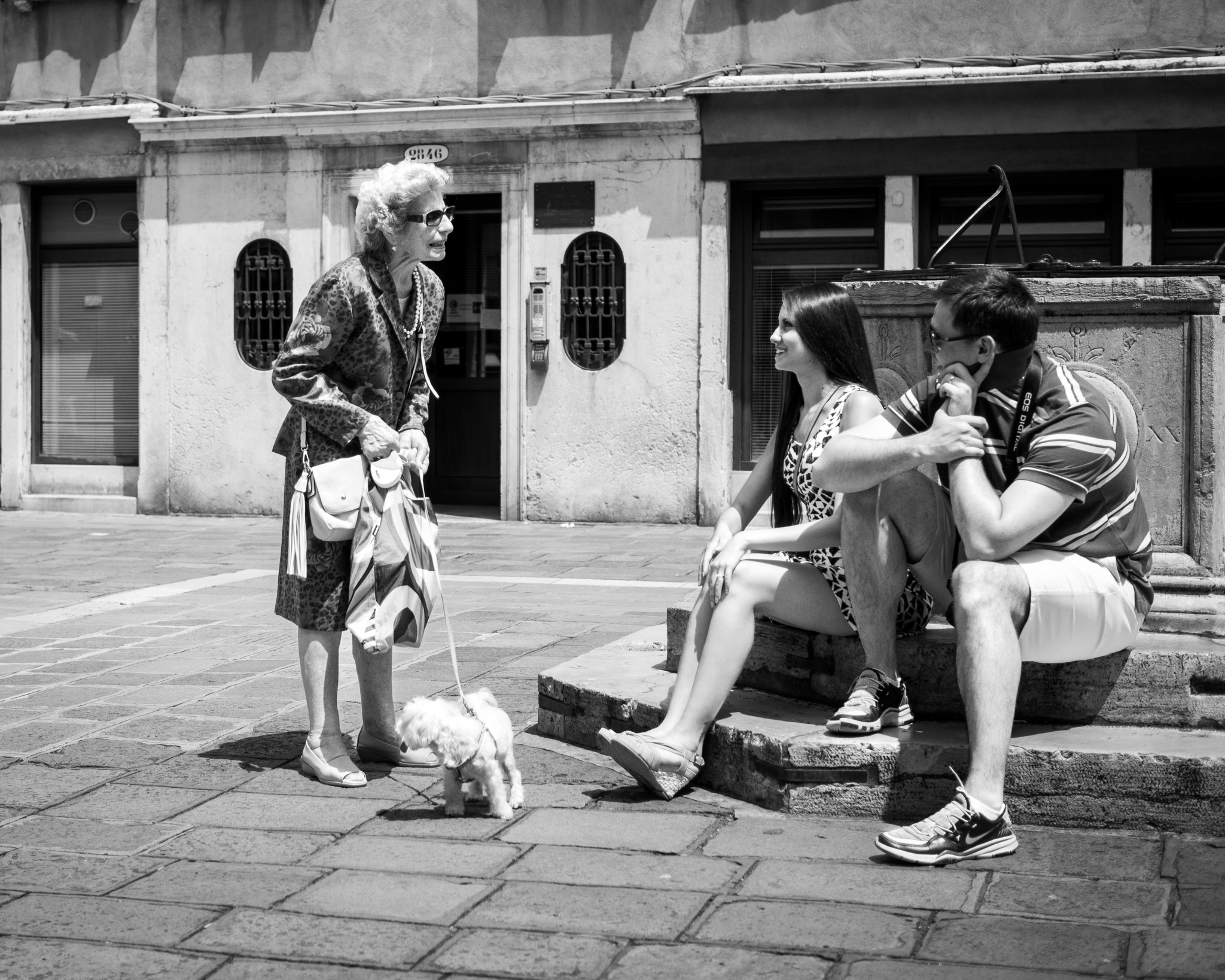
Before I finish, why have I included the above image in this post? It’s because I believe it illustrates elements of each of the above.
- Strong Composition: I’ve cropped the image so the people are the centre of attention with minimum distractions around them.
- Emotional Impact: It captures the joy of a random conversation between tourists and a local, maybe the older lady is telling the couple a story or suggesting somewhere they may visit?
- Compelling Storytelling: It’s a moment in time from daily life of a unique place in the world.
- Unique Perspective: I don’t claim this to be one of Cartier-Bresson’s ‘decisive moments’ but it does capture a fleeting conversation which lasted a few minutes before the lady and couple parted company, possibly never to meet again?
- Everyday Normality: What is more normal than a street conversation like this? It was a fleeting moment in time of a uniquely human interaction – passing time speaking to fellow humans whilst out and about. Nothing special and something that happens millions of times a day somewhere around the world. Looked back on, in a few years time I can almost guarantee this will show a time and a place that is no longer exists and will have a small but unique significance.
Of course, I’m not saying all street photographs must have all of these attributes, some will have only one and some have none at all but will contain other attributes which are important but that I have not identified here. Things such as the use of juxtaposition, strong colour and texture as well, of course, as the elusive “decisive moment” pioneered by Henri Cartier-Bresson.
This is by no means meant to be the definitive statement on what makes a great street photograph (feel free to provide any thoughts you have). Rather, it is the things that I have found work for me based on my own years of experience which I hope you can learn from too.

 Peter Cripps
Leave a comment